
Summary
As a widely utilized inorganic salt boasting strong hygroscopicity, a low freezing point, and excellent stability, calcium chloride is undergoing consistent global market expansion. It is estimated that the global market size of calcium chloride will hit $1.236 billion in 2025, with a steady compound annual growth rate (CAGR) of 4.34% from 2025 to 2032. Fueled by robust demand from sectors including road de-icing, oil and gas extraction, industrial drying, construction, food processing, and pharmaceuticals, the market presents a diversified application pattern. While high-purity food-grade and pharmaceutical-grade products are experiencing faster growth, industrial-grade variants remain the dominant force in the market. Key industry trends include capacity optimization in major production regions, technological upgrades aimed at enhancing product purity, and evolving environmental regulatory frameworks across North America, Europe, and the Asia-Pacific region.
1. Global Market Size & Growth Trend
The global calcium chloride market maintains a stable growth momentum, with demand growth keeping pace with steady capacity expansion. In 2023, the global output of calcium chloride remained at a high level, and the capacity utilization rate stayed above 85%. Demand growth is fueled by infrastructure construction, winter road maintenance, and industrial processing requirements, with an annual demand growth rate of approximately 4.5%.
China stands as the world’s largest producer and exporter of calcium chloride, contributing over 40% of the global output. In the first half of 2025, China’s calcium chloride output reached 1.8175 million tons, a year-on-year increase of 9.94%, and the annual export volume maintained a steady growth rate of over 2.5%. Supported by domestic infrastructure development and industrial demand, the Chinese market is expected to expand continuously in the coming years.
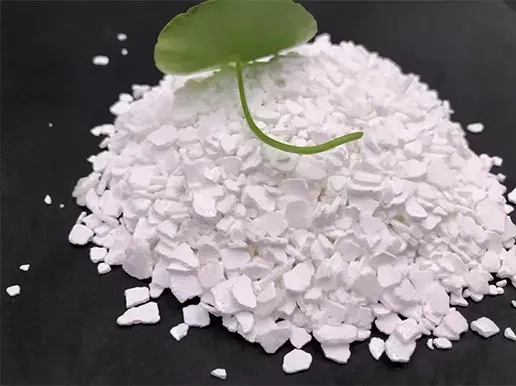
Product prices remain stable, with fluctuations controlled within 3–5%. Optimized production processes and stable raw material supply have alleviated cost pressures, ensuring price consistency. Flake calcium chloride dominates the product structure, accounting for 77% of the total market, while granular and pellet products make up the remaining 23%.
2. Expansion of Core Application Segments
Industrial Grade
Accounting for approximately 65% of the total market share, industrial-grade calcium chloride is primarily applied in road de-icing and anti-skidding, oilfield drilling, industrial drying, concrete antifreeze and accelerators, and wastewater treatment. Road de-icing constitutes nearly 35% of the total industrial demand, making it the largest single application area. Its penetration in reverse osmosis water treatment and industrial gas drying continues to rise, supporting an annual growth rate of 3.8% for this segment.
Food & Pharmaceutical Grade
This high-value segment accounts for around 20% of the market and grows at a CAGR of 5.6%. Food-grade calcium chloride is widely used as a coagulant, preservative, and firming agent in canned foods, dairy products, and aquatic products. Pharmaceutical-grade calcium chloride is utilized in drug excipients and electrolyte supplements, with strict purity requirements (≥99%). Due to rigorous quality standards, North America and Europe lead the consumption of food and pharmaceutical-grade calcium chloride.
Emerging Applications
New applications are emerging in agricultural water retention, new energy material auxiliaries, and environmental protection agents. These sectors drive a 12% annual increase in R&D investment, expanding the application scope of calcium chloride and laying a foundation for long-term market growth.
3. Technological Advancements & Capacity Optimization
Production technologies for calcium chloride have been continuously upgraded, focusing on energy conservation, emission reduction, and purity improvement. Over the past five years, the unit investment cost of large-scale production lines has decreased by approximately 30%, while product purity has been steadily enhanced.
Patent applications related to high-purity and special-form calcium chloride are growing at an annual rate of 15%. Global producers allocate about 60% of their capital expenditure to capacity upgrading for high-purity grades, 30% to production line automation, and 10% to applied R&D.
Production processes are becoming increasingly environmentally friendly, with waste gas and wastewater emissions meeting international standards. This supports the promotion of calcium chloride in green manufacturing and sustainable industries.
4. Regional Market Dynamics
•North America: As the largest regional market, it accounts for 30% of global sales. Strong demand for road de-icing and oilfield applications sustains stable consumption, with a preference for high-purity industrial, food-grade, and pharmaceutical-grade products.
•Europe: The second-largest market, holding a 27% share, driven by demand from the construction and environmental protection sectors. Strict EU chemical regulations are pushing producers to improve product safety and environmental performance.
•Asia-Pacific: Led by China, it is the fastest-growing regional market overall. China’s large-scale manufacturing and infrastructure development drive demand for industrial-grade calcium chloride, while Southeast Asia is experiencing rapid growth in food-grade applications due to upgrades in the food processing industry.
•Middle East & Africa: An emerging market boosted by large-scale infrastructure projects. The rapid expansion of the construction sector drives strong demand for concrete antifreeze and accelerators.
5. Regulatory Landscape & Future Outlook
Global regulatory frameworks for chemicals are becoming increasingly stringent. The U.S. Environmental Protection Agency (EPA) regulates the production and application of calcium chloride under the Toxic Substances Control Act (TSCA), while the EU’s Registration, Evaluation, Authorization and Restriction of Chemicals (REACH) regulation sets clear requirements for chemical safety and environmental impact. These regulations are driving the industry toward high-purity, low-impurity, and eco-friendly products.
Calcium chloride exhibits good biodegradability and low environmental risk, supporting its application in green de-icing, water treatment, and sustainable industrial processes. Future market growth will depend on three core drivers:
1.Compliance with increasingly strict environmental and safety standards
2.Expansion in high-value sectors such as food, pharmaceuticals, and new energy
3.Technological innovation to enhance product purity and performance stability
The global calcium chloride market is expected to maintain steady growth through 2032, with high-purity segments becoming the main driver of industry upgrading.



