

Products Description
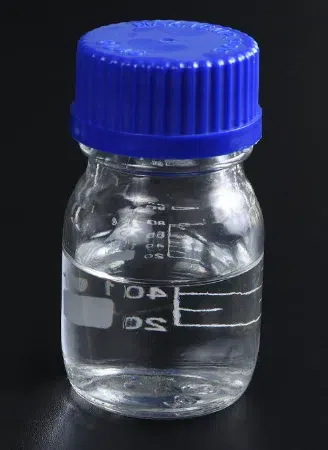
Tetrahydrofuran often abbreviated as THF is a colorless and volatile liquid with an ethereal or acetone‑like odor. It mixes freely with water and nearly all common organic solvents. This chemical is highly flammable and can break down thermally into carbon monoxide and carbon dioxide. When stored for a long time in open air without antioxidant stabilizers THF may form dangerous explosive peroxides.
Chemical Properties
| Item | Value |
| Melting point | -108°C |
| Boiling point | 66 °C |
| density | 0.887 g/mL at 20 °C |
| vapor density | 2.5 vs air |
| vapor pressure | <0.01 mm Hg 25 °C |
| refractive index | n20/D 1.465 |
| Fp | >230 °F |
| storage temp. | Store at +5°C to +30°C |
| solubility | water soluble |
| form | Liquid |
| Specific Gravity | 0.89 |
| color | <10 APHA |
| Odor | Ethereal detectable at 2 to 50 ppm |
| PH | 7-8 200g/l H2O 20℃ |
| PH Range | 7 |
| Relative polarity | 0.207 |
| explosive limit | 1.5-12.4% V |
| Water Solubility | miscible |
| FreezingPoint | -108℃ |
| λmax | λ 245 nm Amax ≤0.26 λ 275 nm Amax ≤0.046 λ 315 μm Amax ≤0.0044 |
| Sensitive | Air Sensitive & Hygroscopic |
| Merck | 14 9211 |
| BRN | 102391 |
| Henry's Law Constant | 1.54 static headspace-GC Welke et al. 1998 |
| Exposure limits | TLV-TWA 200 ppm 590 mg/m3 ACGIH MSHA OSHA STEL 250 ppm ACGIH IDLH 20000 ppm NIOSH |
| Dielectric constant | 11.6 -70℃ |
| Stability | Stable Incompatible with halogens strong oxidizing agents strong reducing agents strong bases oxygen May generate explosive peroxides in storage if in contact with air Highly flammable Store at room temperature under nitrogen Hazardous polymerisation may occur Light sensitive May contain 2 6-di-tertbutyl-4-methylphenol BHT as a stabilizer |
| InChI | 1S/C4H8O/c1-2-4-5-3-1/h1-4H2 |
| InChIKey | WYURNTSHIVDZCO-UHFFFAOYSA-N |
| SMILES | C1CCOC1 |
| LogP | 0.45 at 25℃ |
| Surface tension | 27.31mN/m at 293.15K |
| CAS DataBase Reference | 109-99-9 CAS DataBase Reference |
| NIST Chemistry Reference | Furan tetrahydro- 109-99-9 |
| IARC | 2B Vol. 119 2019 |
| EPA Substance Registry System | Tetrahydrofuran 109-99-9 |
| Absorption | ≤0.0044 at 315nm ≤0.005 at 350nm ≤0.005 at 400nm ≤0.02 at 300nm ≤0.046 at 275nm ≤0.18 at 250nm ≤0.26 at 245nm ≤1.0 at 212nm |
Safety Information
| Item | Value |
| Hazard Codes | Xi F Xn |
| Risk Statements | 36/37/38-36/37-19-11-40 |
| Safety Statements | 26-36-33-29-16-46-37-13 |
| RIDADR | UN 2924 3/PG 2 |
| OEB | A |
| OEL | TWA 200 ppm 590 mg/m3 STEL 250 ppm 735 mg/m3 |
| WGK Germany | 1 |
| RTECS | MD0916000 |
| F | 3-10-23 |
| Autoignition Temperature | 610 °F |
| TSCA | TSCA listed |
| HazardClass | 3 |
| PackingGroup | II |
| HS Code | 29321100 |
| Storage Class | 3 - Flammable liquids |
| Hazard Classifications | Acute Tox. 4 Oral Carc. 2 Eye Irrit. 2 Flam. Liq. 2 STOT SE 3 |
| Hazardous Substances Data | 109-99-9 Hazardous Substances Data |
| Toxicity | LD50 oral rat 2880 mg/kg LC50 inhal rat 21000 ppm 3 h PEL OSHA 200 ppm 590 mg/m3 TLV-TWA ACGIH 200 ppm 590 mg/m3 STEL ACGIH 250 ppm 737 mg/m3 |
| IDLA | 2000 ppm 10% LEL |
Product Application
Tetrahydrofuran is widely used as a solvent for resins vinyl polymers and high‑molecular‑weight materials. It acts as a reliable reaction medium for Grignard reactions organometallic transformations and metal hydride reductions. It is also an important raw material in the chemical synthesis of succinic acid and butyrolactone.
Supply & Delivery
Fast delivery time
Inventory: 2-3 working days
New production: 7-10 working days


