

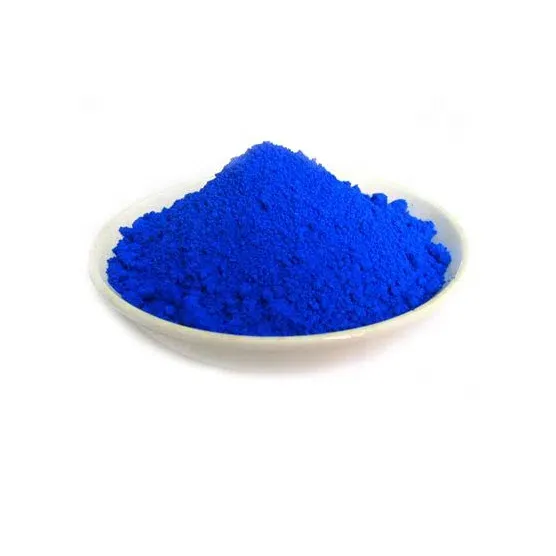
Product Details
Indigo, also known chemically as indigotin, is a widely used blue dye that has been highly prized across history. It has played a key role in global trade and commerce since ancient civilizations. The term “indigo” often refers to a range of blue dyes derived from various plant sources.
For instance, woad — a blue colorant extracted from Isatis tinctoria — was widely used across the Mediterranean region and Europe, and is frequently categorized as indigo. Authentic indigo originates from leguminous plants belonging to the Indigofera genus.
The Indigofera genus includes hundreds of species, and dye has been produced from many of them. The primary cultivated species for commercial indigo are Indigofera tinctoria, mainly grown in India and tropical Asia, and Indigofera suffruticosa, native to tropical America.
The name “indigo” derives from the Greek “indikon” and Latin “indicum,” both meaning “dye from India.” Archeological evidence confirms indigo use dating back several thousand years BCE. Persian carpets dyed with indigo have survived from millennia BCE. Textile artifacts found in Egyptian tombs prove royal use of indigo as early as 2500 BCE. Writings by Herodotus around 450 BCE also mention indigo utilization in the Mediterranean region.
Parameters
| Property | Value |
| Melting point | >300 °C(lit.) |
| Boiling point | 405.51°C (rough estimate) |
| density | 1.01 g/mL at 20 °C |
| vapor pressure | 0Pa at 100℃ |
| refractive index | 1.5800 (estimate) |
| Fp | >220℃ |
| storage temp. | Sealed in dry,Room Temperature |
| solubility | DMSO (Slightly, Heated, Sonicated), DMF (Slightly) |
| pka | -3.83±0.20(Predicted) |
| form | Powder |
| Colour Index | 73000 |
| color | Dark blue to violet |
| Water Solubility | <0.1 g/100 mL |
| ε(extinction coefficient) | ≥8000 at 599-605nm in chloroform |
| λmax | 602 nm |
| Merck | 14,4943 |
| BRN | 88275 |
| Stability: | Stable. Incompatible with strong oxidizing agents. |
| Major Application | diagnostic assay manufacturing hematology histology |
| Cosmetics Ingredients Functions | COLORANT |
| InChI | 1S/C16H10N2O2/c19-15-9-5-1-3-7-11(9)17-13(15)14-16(20)10-6-2-4-8-12(10)18-14/h1-8,17-18H/b14-13+ |
| InChIKey | COHYTHOBJLSHDF-BUHFOSPRSA-N |
| SMILES | O=C1C(\Nc2ccccc12)=C3/Nc4ccccc4C3=O |
| LogP | 2.7 at 23℃ |
| CAS DataBase Reference | 482-89-3(CAS DataBase Reference) |
| NIST Chemistry Reference | c.i. Vat blue 1(482-89-3) |
| EPA Substance Registry System | C.I. Vat Blue 1 (482-89-3) |
Safety Information
| Item | Details |
| Hazard Codes | Xi,Xn |
| Risk Statements | 36/38-36/37/38-48/20/21/22 |
| Safety Statements | 26-36 |
| RIDADR | UN 3264 8/PG 3 |
| WGK Germany | 1 |
| RTECS | DU2988400 |
| TSCA | TSCA listed |
| HS Code | 32041510 |
| Storage Class | 11 - Combustible Solids |
| Hazard Classifications | Eye Irrit. 2 Skin Irrit. 2 STOT SE 3 |
| Hazardous Substances Data | 482-89-3(Hazardous Substances Data) |
| Toxicity | LD50 oral in mouse: > 32gm/kg |
Product Application
| TEST ITEMS | SPECIFICATION |
| APPEARANCE | BLUE POWDER |
| SHADE | GREENISH |
| HEAT RESISTANCE | 180 °C min |
| LIGHT FASTNESS | 7 |
| ACID RESISTANCE | 3 |
| ALKALI RESISTANCE | 4 |
| FASTNESS TO BLEEDING | 4 |
| OIL ABSORPTION | 40-50% |
| SPECIFIC SURFACE | 27 m2/g |
| DENSITY | 1.60 g/cm3 |
| RESIDUE ON 80 MESH | 5.0% max |
| WATER SOLUBLE | 1.0% max |
| VOLATITE 105 °C | 1.0% max |
| TINTING STRENGTH | 100-105 % |
Fast delivery time
Inventory 2-3 working days New production 7-10 working days.


