

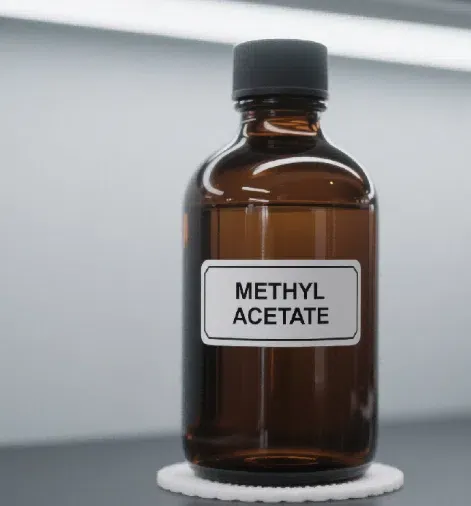
Product Details
Physical & Chemical Properties
Methyl acetate is a typical carboxylate ester with molecular structure CH₃COOCH₃. It is a highly flammable liquid featured with a sweet, pleasant ethereal odor similar to glue and nail polish remover. It belongs to weakly polar and lipophilic solvent, while ethyl acetate is more widely adopted in industrial production due to lower toxicity and lower water solubility compared with methyl acetate.
Core Physical Index
- Melting Point: -98 °C
- Boiling Point: 57–58 °C
- Relative Density (25 °C): 0.934 g/mL
- Flash Point: -10 °C
- Vapor Pressure (20 °C): 165 mmHg
- Explosion Limit in Air: 3.1%–16% (V/V)
- Water Solubility: 250 g/L under room temperature; solubility rises sharply when temperature increases
Chemical Stability & Regulatory Feature
This product exhibits poor stability when exposed to strong aqueous acid or strong aqueous base solutions, and hydrolysis reaction will occur rapidly under such environments. It is classified as VOC-exempt solvent under relevant U.S. environmental regulations, which brings obvious advantages for low-VOC formulation production.
Parameters
| Property | Value |
| Melting point | -98 °C (lit.) |
| Boiling point | 57-58 °C (lit.) |
| density | 0.934 g/mL at 25 °C |
| vapor density | 2.55 (vs air) |
| vapor pressure | 165 mm Hg ( 20 °C) |
| refractive index | n20/D 1.361(lit.) |
| FEMA | 2676 | METHYL ACETATE |
| Fp | 3.2 °F |
| storage temp. | no restrictions. |
| solubility | 250g/l |
| form | Solution |
| color | Clear colorless to slightly pale yellow |
| Relative polarity | 0.253 |
| Odor | Slightly acrid, sweet; fragrant. |
| PH | 7 |
| biological source | synthetic |
| Odor Threshold | 1.7ppm |
| Odor Type | ethereal |
| explosive limit | 3.1-16%(V) |
| Water Solubility | 250 g/L (20 ºC) |
| λmax | λ: 255 nm Amax: 1.0 λ: 275 nm Amax: 0.1 λ: 300 nm Amax: 0.01 |
| Merck | 14,6008 |
| JECFA Number | 125 |
| BRN | 1736662 |
| Henry's Law Constant | 0.90 at 20.00 °C, 1.56 at 30.00 °C (headspace-GC, Hovorka et al., 2002) |
| Exposure limits | TLV-TWA 200 ppm (~610 mg/m3) (ACGIH, MSHA, and OSHA); TLV-STEL 250 ppm (~760 mg/m3) (ACGIH); IDLH 10,000 ppm (NIOSH). |
| Dielectric constant | 7.3(20℃) |
| Stability: | Stable. Extremely flammable - readily forms explosive mixtures with air. Note low flash point and wide explosion limits. Incompatible with strong oxidizing agents, strong bases, strong acids, nitrates. May be moisture sensitive. |
| Cosmetics Ingredients Functions | PERFUMING SOLVENT |
| LogP | 0.18 at 20℃ |
| Surface tension | 25.4mN/m at 298.15K |
| CAS DataBase Reference | 79-20-9(CAS DataBase Reference) |
| NIST Chemistry Reference | Acetic acid , methyl ester(79-20-9) |
| EPA Substance Registry System | Methyl acetate (79-20-9) |
Safety Information
| Item | Details |
| Hazard Codes | F,Xi |
| Risk Statements | 11-36-66-67 |
| Safety Statements | 16-26-29-33 |
| OEB | A |
| OEL | TWA: 200 ppm (610 mg/m3), STEL: 250 ppm (760 mg/m3) |
| RIDADR | UN 1231 3/PG 2 |
| WGK Germany | 1 |
| RTECS | AI9100000 |
| Autoignition Temperature | 936 °F |
| TSCA | Yes |
| HS Code | 2915 39 00 |
| HazardClass | 3 |
| PackingGroup | II |
| Hazardous Substances Data | 79-20-9(Hazardous Substances Data) |
| Toxicity | LD50 orally in Rabbit: > 5000 mg/kg LD50 dermal Rat > 2000 mg/kg |
| IDLA | 3,100 ppm [10% LEL] |
Product Application of Methyl acetate CAS#79-20-9
Main Industrial Applications
Methyl acetate serves as both an essential reaction raw material for ester synthesis and a low-VOC industrial solvent, covering biofuel manufacturing, fine chemical intermediate production and ester interchange reaction fields:
Biodiesel & Biofuel Raw Material
Acts as acyl acceptor to produce biodiesel through transesterification reaction
Prepares fatty acid methyl esters and triacetin from rapeseed oil via non-catalytic supercritical transesterification
Ester Interchange Synthesis
Produces n-butyl acetate by transesterification reaction with n-butanol under acidic catalyst conditions
Fine Chemical Intermediate Precursor
It is a key starting material for synthesizing multiple mainstream chemical products, including:
- Acetic anhydride
- Methyl acrylate
- Vinyl acetate
General Industrial Solvent
Can be used as a low-toxicity, VOC-exempt solvent for light industrial formulations where weak polar lipophilic dissolving capacity is required.
Factory and Equipment Show
Fast delivery time
Inventory 2-3 working days New production 7-10 working days
FAQ
FAQ 1: What transportation and packaging solutions do you supply for methyl acetate 1 FCL bulk order?
We provide two mature packaging options for full container shipment: 200L sealed galvanized steel drums with anti-static treatment, and ISO stainless steel tank containers for large-volume bulk delivery. As a Class 3 flammable liquid (UN 1231, Packing Group II), all goods will be shipped with complete MSDS, hazard identification labels and customs declaration documents to meet international sea and land transport standards.
FAQ 2: What storage conditions should be followed for methyl acetate long-term storage?
Store sealed product in cool, ventilated warehouses with temperature controlled below 25°C, away from open flames, static electricity and ignition sources. Separate storage from strong oxidants, strong acids and strong alkaline substances to avoid hydrolysis and violent chemical reactions. Stainless steel or lined carbon steel containers are recommended for long-term bulk storage; HDPE plastic tanks are not suitable for prolonged storage of methyl acetate.


