

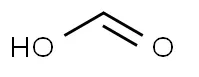
Product Details
Formic acid (HCO2H), also known as methanoic acid, is the simplest carboxylic acid. It was first obtained through distillation of ant bodies, and its name derives from the Latin word “formica” meaning “ant.” The official IUPAC name is methanoic acid. Industrially, formic acid is synthesized by reacting carbon monoxide with an alcohol like methanol under catalytic conditions.
Formic acid exists both in natural sources and is widely prepared in laboratories. It is naturally present in the stings and bites of numerous insects such as bees and ants as a defensive chemical.
Parameters
| Property | Value |
| Melting point | 8.2-8.4 °C (lit.) |
| Boiling point | 100-101 °C (lit.) |
| density | 1.22 g/mL at 25 °C (lit.) |
| vapor density | 1.03 (vs air) |
| vapor pressure | 52 mm Hg (37 °C) |
| refractive index | n20/D 1.377 |
| FEMA | 2487 | FORMIC ACID |
| Fp | 133 °F |
| storage temp. | 2-8°C |
| solubility | H2O: soluble 1g/10 mL, clear, colorless |
| pka | 3.75 (at 20℃) |
| form | Liquid |
| color | APHA: ≤15 |
| Specific Gravity | 1.216 (20℃/20℃) |
| PH | 3.47 (1 mM solution); 2.91 (10 mM solution); 2.38 (100 mM solution) |
| Odor | at 0.10 % in water. pungent vinegar formyl |
| Odor Type | acetic |
| biological source | synthetic |
| explosive limit | 12-38%(V) |
| Water Solubility | MISCIBLE |
| λmax | λ: 260 nm Amax: 0.03; λ: 280 nm Amax: 0.01 |
| Sensitive | Hygroscopic |
| Merck | 14,4241 |
| JECFA Number | 79 |
| BRN | 1209246 |
| Henry's Law Constant | At 25 °C: 95.2, 75.1, 39.3, 10.7, and 3.17 at pH values of 1.35, 3.09, 4.05, 4.99, and 6.21, respectively (Hakuta et al., 1977) |
| Exposure limits | TLV-TWA 5 ppm (~9 mg/m3) (ACGIH, MSHA, OSHA, and NIOSH); IDLH 100 ppm (180 mg/m3) (NIOSH) |
| Dielectric constant | 58.0(16℃) |
| Stability | Stable. Substances to be avoided include strong bases, strong oxidizing agents and powdered metals, furfuryl alcohol. Combustible. Hygroscopic. Pressure may build up in tightly closed bottles, so bottles should be opened carefully and vented periodically. |
| InChIKey | BDAGIHXWWSANSR-UHFFFAOYSA-N |
| LogP | -0.540 |
| CAS DataBase Reference | 64-18-6 (CAS DataBase Reference) |
| NIST Chemistry Reference | Formic acid (64-18-6) |
| EPA Substance Registry System | Formic acid (64-18-6) |
Safety Information
| Item | Detail |
| Hazard Codes | T,C,Xi |
| Risk Statements | 23/24/25-34-40-43-35-36/38-10 |
| Safety Statements | 36/37-45-26-23-36/37/39 |
| RIDADR | UN 1198 3/PG 3 |
| OEB | B |
| OEL | TWA: 5 ppm (9 mg/m3) |
| WGK Germany | 2 |
| RTECS | LP8925000 |
| F | 10 |
| Autoignition Temperature | 1004 °F |
| TSCA | Yes |
| HazardClass | 8 |
| PackingGroup | II |
| HS Code | 29151100 |
| Hazardous Substances Data | 64-18-6 (Hazardous Substances Data) |
| Toxicity | LD50 in mice (mg/kg): 1100 orally; 145 i.v. (Malorny) |
| IDLA | 30 ppm |
Product Application of Formic acid CAS#64-18-6
Formic acid has a wide range of commercial applications. In the leather industry, it is used for degreasing and dehairing hides, as well as an ingredient in tanning products. It serves as a latex coagulant in natural rubber manufacturing. Formic acid and its formulations are utilized as silage preservatives. It is particularly popular in Europe where regulations favor natural antibacterial agents over synthetic antibiotics.
Silage refers to fermented grasses and crops stored in silos for winter livestock feed. It forms via anaerobic fermentation where bacteria produce acids to lower pH and inhibit further bacterial activity. Acetic acid and lactic acid are the target acids in silage fermentation. Formic acid is added during silage processing to suppress harmful bacteria and mold growth. It reduces Clostridia species that produce butyric acid and cause spoilage. Besides preventing spoilage, formic acid helps retain protein, improve compaction, and preserve sugar content. It is also used by beekeepers as an effective miticide.
Factory and Equipment Show
Fast delivery time
Inventory: 2–3 working days
New production: 7–10 working days


