

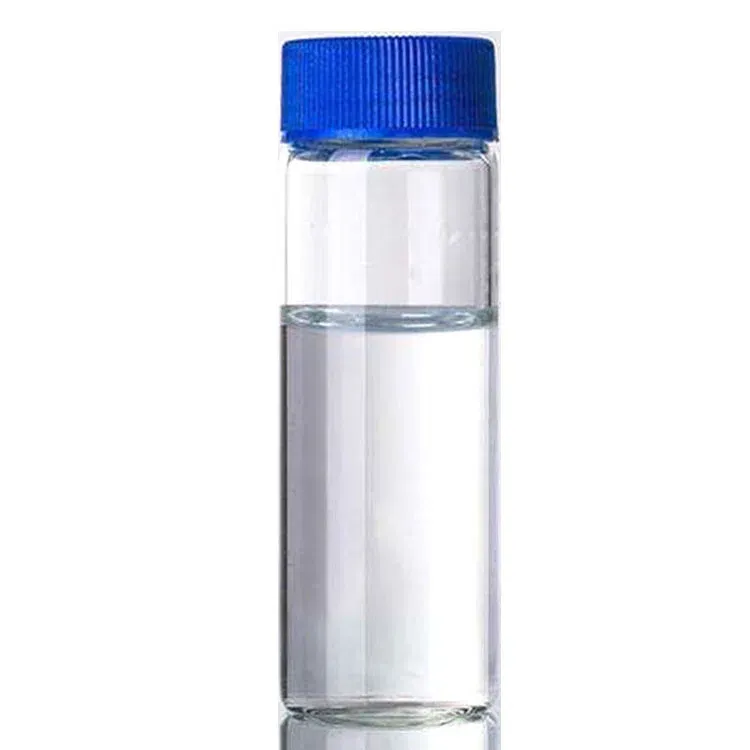
Product Details
Monoethanolamine CAS#141-43-5
Ethanolamine is a viscous hygroscopic amino alcohol that contains both amine and hydroxyl functional groups. It occurs naturally in biological systems and is part of lecithin. It has wide industrial uses, including production of agrochemicals, pharmaceuticals, and detergents. It serves as a surfactant, fluorometric reagent, and scrubbing agent for CO2 and H2S. In medicine, it acts as a vascular sclerosing agent and exhibits antihistaminic activity that relieves adverse effects linked to H1-receptor binding.
Parameters
| Property | Value |
| Melting point | 10-11 °C(lit.) |
| Boiling point | 170 °C(lit.) |
| density | 1.012 g/mL at 25 °C(lit.) |
| vapor density | 2.1 (vs air) |
| vapor pressure | 0.2 mm Hg (20 °C) |
| refractive index | n20/D 1.454(lit.) |
| Fp | 200 °F |
| storage temp. | Store at +15°C to +25°C. |
| solubility | Soluble in benzene, ether, carbon tetrachloride. |
| form | Liquid |
| pka | 9.5(at 25℃) |
| Specific Gravity | 1.012 |
| color | APHA: ≤15 |
| Odor | ammoniacal odor |
| PH | 12.1 (100g/l, H2O, 20℃) |
| Relative polarity | 0.651 |
| biological source | synthetic |
| explosive limit | 3.4-27%(V) |
| Water Solubility | miscible |
| Sensitive | Air Sensitive & Hygroscopic |
| Merck | 14,3727 |
| BRN | 505944 |
| Henry's Law Constant | 1.61(x 10-10 atmm3/mol) at 20 °C (Bone et al., 1983) |
| Exposure limits | TLV-TWA 3 ppm (~7.5 mg/m3) (ACGIH, MSHA, and OSHA); TLV-STEL 6 ppm (~15 mg/m3) (ACGIH); IDLH 1000 ppm (NIOSH). |
| Dielectric constant | 31.940000000000001 |
| Stability: | Stable. Flammable; incompatible with strong oxidizing agents, strong acids. Hygroscopic. |
| Cosmetics Ingredients Functions | BUFFERING |
| Cosmetic Ingredient Review (CIR) | Monoethanolamine (141-43-5) |
| InChI | 1S/C2H7NO/c3-1-2-4/h4H,1-3H2 |
| InChIKey | HZAXFHJVJLSVMW-UHFFFAOYSA-N |
| SMILES | NCCO |
| LogP | -2.3--1.91 at 25℃ |
| Surface tension | 48.48mN/m at 293.15K |
| CAS DataBase Reference | 141-43-5(CAS DataBase Reference) |
| NIST Chemistry Reference | Ethanolamine(141-43-5) |
| EPA Substance Registry System | Ethanolamine (141-43-5) |
Safety Information
| Item | Value |
| Hazard Codes | T,C |
| Risk Statements | 20/21/22-34-39/23/24/25-23/24/25-10-52/53 |
| Safety Statements | 26-36/37/39-45-61 |
| RIDADR | UN 2924 3/PG 3 |
| OEB | B |
| OEL | TWA: 3 ppm (8 mg/m3), STEL: 6 ppm (15 mg/m3) |
| WGK Germany | 1 |
| RTECS | KJ5775000 |
| F | 8-10-23 |
| Autoignition Temperature | 410 °C |
| TSCA | TSCA listed |
| HazardClass | 8 |
| PackingGroup | III |
| HS Code | 29221100 |
| Storage Class | 8A - Combustible corrosive hazardous materials |
| Hazard Classifications | Acute Tox. 4 Dermal; Acute Tox. 4 Inhalation; Acute Tox. 4 Oral; Aquatic Chronic 3; Eye Dam. 1; Skin Corr. 1B; STOT SE 3 |
| Hazardous Substances Data | 141-43-5(Hazardous Substances Data) |
| Toxicity | LD50 orally in rats: 10.20 g/kg (Smyth) |
| IDLA | 30 ppm |
Product Application
Monoethanolamine is mainly used in pharmaceutical formulations for pH buffering and emulsion preparation. It also acts as a solvent for fats and oils and stabilizes injectable dextrose solutions of phenytoin sodium.
It is used to synthesize various therapeutic salts. For instance, its vitamin C salt is used for intramuscular injection; its salicylate salt treats rheumatism; and its undecenoate salt acts as an antifungal agent. Its most common medical use is in ethanolamine oleate injection, a widely used sclerosing agent.
Fact Factory and Equipment Show
Fast delivery time
Inventory 2-3 working days New production 7-10 working days.


